Taro, Dasheen, Eddo

Colocasia esculenta
banner
Appears in

By Elizabeth Schneider

Published 2001

  • About

Also cocoyam or old cocoyam, coco, eddoes, colocasia, malanga and malanga isleña (Latin American), satoimo (Japanese), woo tau (Chinese), gabi (Philippine), arbi or arvi and patra (Indian)

TARO LEAVES

Is it possible to summarize briefly the significance of an Old World plant that has been a staff of life in warm, humid regions worldwide? A plant that has probably been cultivated for 10, 000 years— longer than wheat or barley? A food so common that it has hundreds of current names (including some of the American market names selected above)? No, I’m sad to say. Moreover, although the Food and Agriculture Organization of the United Nations lists 44 countries that grew taro in 1999, and the University of Hawaii lists 85 present cultivars, when it comes to mainland North America taro is just another “ethnic vegetable.”

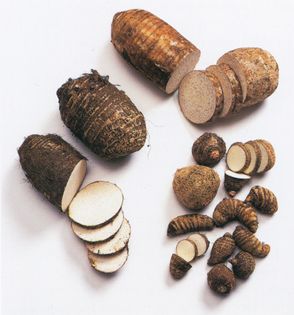
Here is the restricted version for the mainland United States: New Americans from the tropics (for the most part), have brought with them a taste for two basic types of taro. One, most often called taro or dasheen (see left and top of photo), is represented by large, barrel-shaped, often shaggy, ringed and ridged corms (not roots). Their exceptionally dense flesh (rather like coconut compressed with potato) may be white, cream, lilac-gray, pinkish, or marbled or speckled with chocolate fibers. The cooked flavor and texture, too, are reminiscent of coconut and potato, with a nice dose of chestnut—dry and sweet.

The second type is represented by the little cormels pictured on the lower right, often called eddoes or Chinese taro (and sometimes designated as a subspecies or variety, antiquorum). These are variously shaped like tops, kidneys, and crescents, some sprouting nipple-like pink tips (these are called red-budded taro). Cooked, they are more moist, bland, and slippery than the larger types. They are generally preferred by shoppers with family roots in China, Japan, and parts of the Caribbean—where the cormels are always called eddoes, as they often are by American distributors.

Although taro’s culinary history is associated primarily with Asia, the Pacific, the Caribbean, and Hawaii, Paula Wolfert reminds us that taro was a prevalent starch in the Mediterranean before the potato traveled there from the New World. She writes that it is “still eaten widely in Egypt in a dish called oulaas, as well as in Cyprus and along the Turkish Mediterranean coast” (Mediterranean Grains and Greens’). “Still” signifies a long time in this case, for Egyptian taro was described in the first century by the Roman naturalist Pliny.

Perhaps unfortunately, taro’s most publicized role is as Hawaiian poi, a dish that is very much an acquired taste and texture—and differs from just about all other taro preparations. Taro is a national dish not only in Hawaii, but in the Philippines, where it is eaten countrywide. There is little culinary variation (it is almost always prepared with coconut milk and chilli) but some curious specificity. Gilda Cordero-Fernando writes in Philippine Food and Life, “Bikolanos cook and eat only the leaves. In Tarlac, the leaves are thrown away and only the stems are eaten. Both stems and leaves . . . are cooked and eaten by the inhabitants of Laguna. In most other provinces, people consume only the . . . tuber, ignoring all other parts.” The nuances of taro are fascinating—but I seem to have strayed from the mainland United States. Let’s get back to basics.